
This article was originally published in the Washington Post
By Shawn Fain
Thousands of jobs in higher education are at stake.
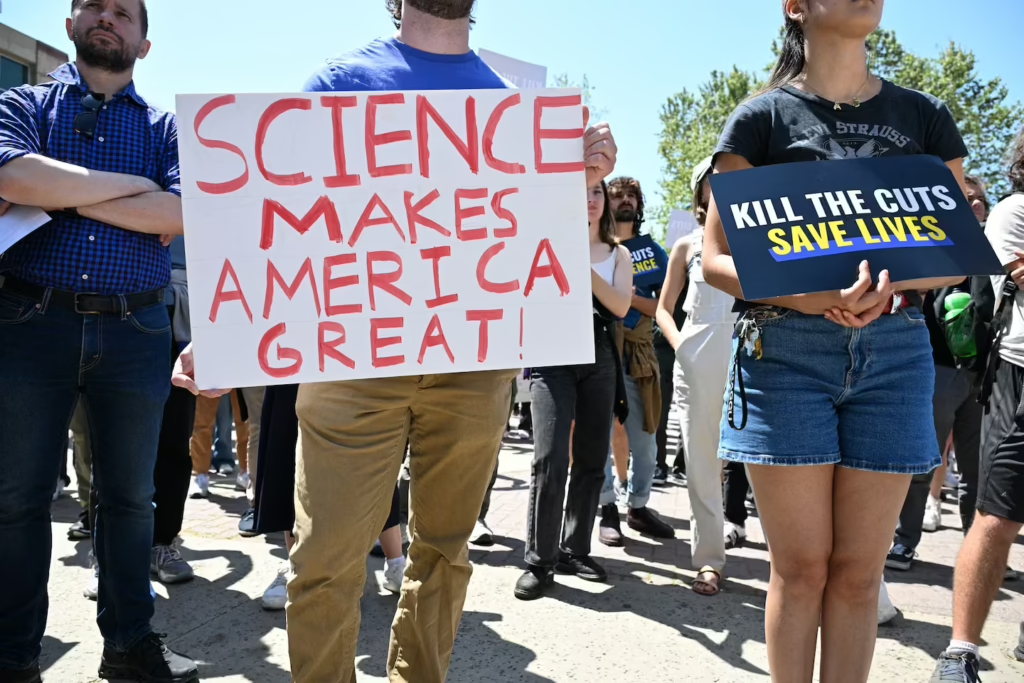
Over the past year, the Trump administration has relentlessly pursued making deep cuts to federally funded research — while simultaneously cutting taxes for billionaires. Scientific research, long a cornerstone of American economic progress, has been increasingly endangered by the White House’s warped priorities.
The implications are not abstract. The University of California system alone — where the United Auto Workers union, the organization I lead, represents 60,000 workers, including academic employees and researchers — risks losing between $5 billion and $6 billion every year from the Trump administration’s cuts. The UAW represents more than 120,000 academic workers across the country, many of whom work on the bleeding edge of innovation, all of whom are at risk.
We’re already seeing the consequences: Scientists are being laid off, labs are going dark, and projects aimed at curing devastating diseases — cancer, heart disease, diabetes, Parkinson’s, Alzheimer’s — are being halted in their tracks. Think about what that means: fewer clinical trials, fewer breakthroughs, fewer chances for families to hear the words, “We found a treatment.” In fields where time is often measured in lives saved, such interruptions carry a cost that cannot easily be recouped.
Against this disturbing backdrop, California is considering an unusual intervention. California Senate Bill 895, the California Science and Health Research Bond Act, poses a fundamental question to voters: Who should decide the direction of scientific investment when the federal government falters?
The legislation’s solution is starting a foundation, advised by a council of experts, with the council establishing the foundation’s research priorities, and funding awarded accordingly, based on “the scientific merit of the proposed research, as determined by an open, competitive, scientific peer review process that ensures objectivity, consistency, and high quality.” The foundation would be of Californians, for Californians, to advance projects and research in line with the state’s values.
If passed by the legislature and signed by Gov. Gavin Newsom (D), the bill would place a measure on the state’s November 2026 ballot funding up to $23 billion worth of scientific research at California institutions. It would give people — not political appointees or corporate lobbyists, as too often happens in Washington — the power to prioritize the research that matters most to their lives and their families.
That’s what democracy is supposed to look like.
To put the cost of the bill in perspective, California sends $83 billion more to the federal government every year than it gets back. So when federal administrators threaten to gut the very research that saves lives and drives the economy, voters have every right to say: Enough.
This is about taking control of the future. It’s about keeping the wheels of innovation turning and making sure crucial datasets remain grounded in truth — not twisted by “alternative facts.” It’s about ensuring the guiding light of scientific progress doesn’t go dark because of political gamesmanship, or corporations prioritizing their tax cuts over investments in our collective future.
California knows this. It has been a leader on labor rights, environmental protections and social progress. But leadership isn’t about past accomplishments — it’s about what you do right now, when the pressure is on.
California’s legislators and governor have a choice. They can stand with science, with the workers and innovations that power California’s economy, and with the millions of people across the country who are hoping for cures, or they can capitulate to the Trump administration and its billionaire backers. Signing S.B. 895 would send a clear message: California is still a place where science matters, and California is willing to lead on issues that matter to working people when Washington won’t.
S.B. 895 will set this standard — not just for California, but for the nation. Other states, including New York, Texas and Massachusetts, are moving in this direction as well. And the UAW is with them.
What California does or fails to do in this moment will be felt for generations to come. The first step is to put the California Science and Health Research Bond Act on the ballot, and then voters will have a chance to put their values into action.
Shawn Fain is the president of the United Auto Workers International Union.