
This article was originally published in the San Francisco Chronicle
By: Rob Schwartz
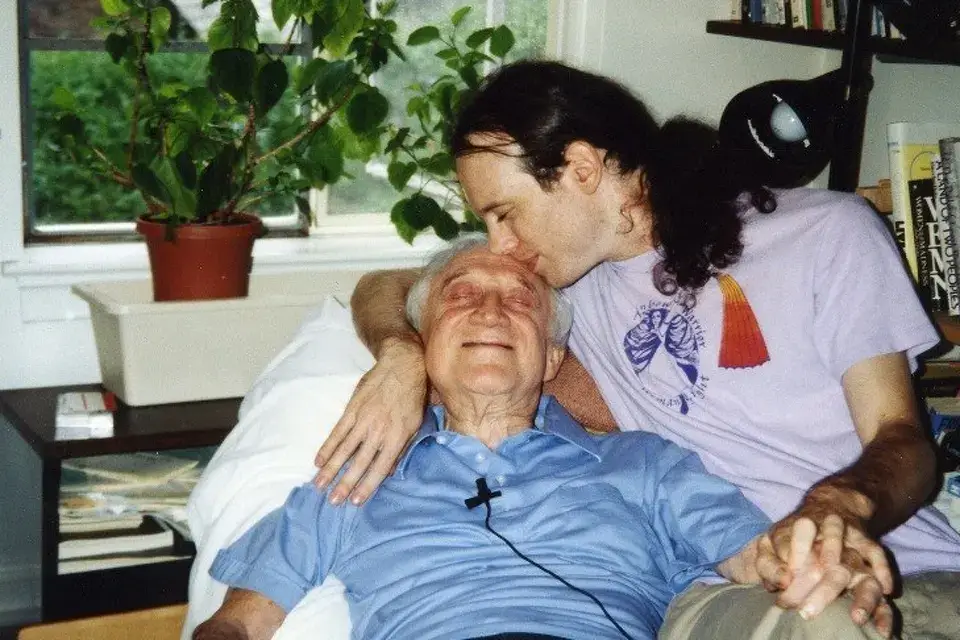
In Mitch Albom’s best-selling book “Tuesdays with Morrie,” my father, Morrie Schwartz, taught millions of readers how to live with grace, connection and purpose — even as he faced death from amyotrophic lateral sclerosis.
More than 30 years after his death, my dad’s voice still resonates, but so does the disease that silenced it. ALS remains a devastating, terminal diagnosis with no known cure and only limited treatment options. And while scientific progress is happening, it’s happening far too slowly — largely because ALS research remains severely underfunded.
That’s why I strongly support California Senate Bill 895, which was introduced by Sen. Scott Wiener of San Francisco. It would authorize the issuance of $23 billion in bonds to invest in critical medical research for devastating diseases like ALS at a level that truly matches the urgency of the challenge. Even allocating just 1% of the bill’s funding to ALS would match what was raised during the iconic Ice Bucket Challenge in 2015, demonstrating the transformative impact this legislation could have.
As Morrie’s son, my family and I witnessed the relentless progression of ALS firsthand. We saw a vibrant, joyous and animated man lose the use of his body while his mind stayed painfully alert. We watched him first struggle to walk, and then move at all. Toward the end, it was hard for Dad to breathe and speak. But he continued teaching and inspiring from his wheelchair. Thanks to collaborators like Ted Koppel and Albom, Dad turned his final months into a gift to the world. For the family, that message of resilience and community was mixed with suffering and heartbreak. That suffering and heartbreak continue for thousands of other families today.
Roughly 30,000 people in the United States live with ALS at any given time. About 5,000 Americans are diagnosed each year. And yet, federal funding for ALS research remains disproportionately low. The National Institutes of Health allocated about $131 million to ALS in 2023. That’s a small fraction compared to the more than $3 billion spent on Alzheimer’s disease. Both are serious neurodegenerative disorders that destroy people’s autonomy and futures — yet ALS receives only a sliver of support.
Progress is being made, however. Scientists have identified dozens of genetic markers linked to ALS. Researchers are developing promising therapies using RNA and gene-editing techniques. New treatment candidates are being tested that target protein buildup, inflammation and nerve degeneration. Emerging technologies like mRNA are being adapted to address ALS. This momentum is the result of sustained, though limited, federal investment. Imagine what could be achieved if we funded ALS research at the level it truly deserves.
The challenge isn’t just one of scientific potential. It’s also political will. We already have brilliant scientists. We have biotech companies eager to partner. We have patients willing to participate in trials and share their experiences. What we need is the commitment to see the search for a cure through to a conclusion — to protect and grow funding so that ideas can become treatments and treatments can become cures.
This is not first and foremost about science. It’s about values — what we value as a society. Dad spent his life teaching that love and compassion are what give life meaning. He stressed it was crucial to give back to your community, especially the most vulnerable in it. Investing in ALS research is an extension of that belief. It’s a statement that we, as Americans, believe in community and tackling difficult problems.
Some argue that we can’t fund everything, that difficult choices must be made. But when we underfund ALS research, we’re not making a hard choice — we’re making an easy excuse. The cost of doing too little is measured not just in lives lost, but in the pain of families watching someone they love slip away, day by day, with no real hope, as my family experienced.
Dad knew he would not live to see a cure. But he never stopped hoping — not for himself, but for the future. He deeply believed in the power of people to come together to change the course of our shared destiny. That belief lives on in me — and in the countless families who are fighting for time, for answers and for something better.
We have the tools. We have the knowledge. What we need now is the will. We shouldn’t waste the progress we’ve made. Instead, we should protect and expand federal funding for ALS research and pass SB895 to speed up that research in California. That way, we can fully commit to ending this terrible disease.